The Thin Argument: A Considered Case for the Card Case
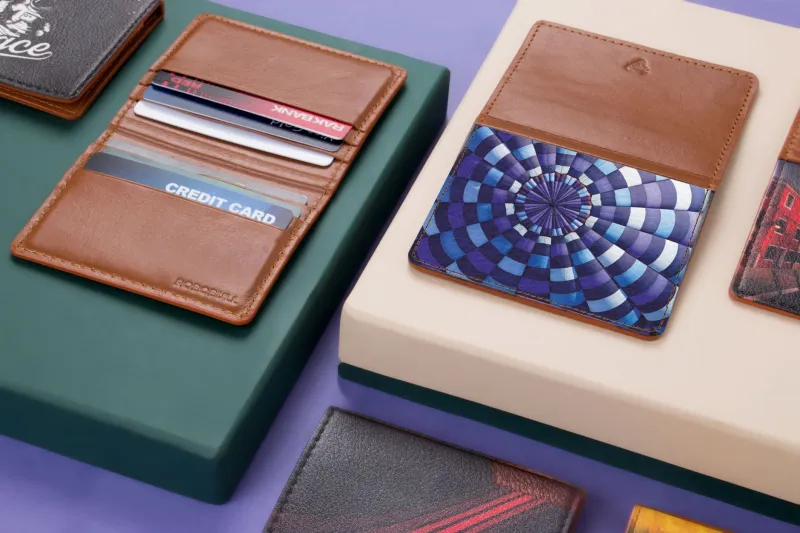
There was a period, not so long ago, when the wallet was expected to prove itself through bulk. A fold thick enough to distort a jacket pocket was read as a sign of seriousness, as though the sheer volume of paper inside stood in for a life fully lived. That reading no longer holds. Contactless payment, digital tickets and the general thinning of the British pocket have made a virtue of subtraction, and the card case has emerged as the more articulate object.
What follows is not an argument against the wallet so much as an argument for a smaller, better-made version of it. The card case asks more of its maker and less of its owner: fewer cards, clearer choices, and a construction that has to survive being handled every single day.
Why Fewer Cards Is the More Honest Position
A card case imposes a discipline that most of us need. Four to eight cards is the realistic range; beyond that, the leather begins to splay, the edges strain and the object loses the flat, confident profile that made it desirable in the first place. This is not a limitation to be worked around but the point of the thing.
Consider what actually travels with you: a debit card, a credit card, a travel card or its contactless equivalent, a driving licence, perhaps a membership card and a single folded note for the places that still prefer one. That is the whole of a working day in Britain. Everything else — loyalty schemes, gift cards, the receipts you keep meaning to file — belongs somewhere else.
The result is a case that sits flat in a jacket breast pocket, disappears into a coat and never announces itself at a restaurant table. It is, in the most literal sense, understated.
Judging the Leather Before the Label
The leather does most of the work, and it is where the money should go. Full-grain hides, in which the surface has been left largely intact, will develop a patina rather than a scuff pattern. Vegetable-tanned leathers — bridle and some calfskins among them — begin firm and slightly stiff, then soften into the shape of the pocket within a month of use. Chrome-tanned alternatives arrive softer and more uniform, which is agreeable on the first day and less so in the second year.
Pressing a thumbnail gently into the surface tells you a good deal. A hide of quality will show a temporary mark that fades; a corrected-grain leather, sanded smooth and stamped with an artificial pattern, will resist and look waxy. Neither approach is dishonest, but only one of them gets better with age.
Colour is a practical matter as much as an aesthetic one. Ink and oxblood conceal the small abrasions of daily carriage; a pale tan will record every one of them and, handled without fuss, look all the better for it.
What the Stitching and Edges Reveal
Turn the case over. The stitching should be tight, evenly spaced and slightly sunk into the leather rather than floating on the surface. A saddle stitch — two needles, one waxed thread — is the standard worth paying for, because a break in one stitch does not unravel the seam as a machine lockstitch can.
Then look at the edge. Painted edges should be thin, smooth and applied in several coats; burnished edges should show the grain compressed and darkened rather than sealed under a plastic sheen. Edges are also the first place a cheap case fails, splitting or peeling where the two panels meet. A well-finished edge will simply round off with handling.
Finally, check the lining. An unlined case will stretch more readily and take on the shape of your cards; a lined one is tidier but slightly bulkier. Neither is wrong. What matters is that the lining is leather or a dense textile rather than a thin synthetic that will wear through at the corners within a year.
How a Good Case Ages
Expect three changes. The leather will darken slightly and take on a soft sheen at the corners where thumb and forefinger meet it. The pocket will mould to the exact stack of cards you carry, which is why a case bought for eight and used for five will always look slightly slack. And the edges will soften, losing their crispness in a way that reads as familiarity rather than damage.
A card case kept out of a back pocket — where it will be sat upon, bent and eventually cracked — will last a decade or more. Kept in a jacket or coat, cleaned occasionally with a dry cloth and fed perhaps twice a year, it asks almost nothing.
A Concise Edit
For the commute. A bridle-leather case in ink or black, four to six card slots and no note compartment, so that it stays under five millimetres at the spine. It should slip into an inside jacket pocket without breaking the line of the lapel — the small test that separates a good case from a merely pretty one.
For the weekend. A softer, unlined calfskin case in tan or chestnut, with a single external slip pocket for a rail ticket or a folded twenty. The lack of structure is deliberate: it should collapse into a coat pocket and recover its shape when retrieved.
For formal occasions. A slim shell cordovan case, dark and quietly glossy, with hand-painted edges and no visible branding. Cordovan creases in rolling folds rather than sharp lines, which suits an evening where nothing should look hurried.
For the long term. A vegetable-tanned case in oxblood with a saddle-stitched perimeter and a single note sleeve — the version most likely to be carried for fifteen years and handed on in decent condition.
The wallet is not obsolete. But for the reader who has already begun to edit, the card case is the more considered object: smaller, more demanding of its maker, and rather more honest about how much any of us actually needs to carry.